Quick verdict
AdSpy has been the reference Facebook and Instagram ad spy tool since 2015. Its Boolean search operators are the deepest in the category — (hook_rate AND native) NOT brand_ads kind of queries are native to AdSpy and absent everywhere else. Historical Meta ad database goes back the longest of any competitor reviewed here.
The weaknesses are structural. The UI is substantially unchanged since 2018. There’s no landing page capture, no affiliate-offer directory, no creative grouping across advertisers, no free trial. Pricing is recurring at $149/mo — no lifetime option, no cheaper entry tier.
Who AdSpy fits: solo affiliates running Meta-only campaigns, comfortable with the older UI, prioritizing Boolean search and historical depth over modern features. Who AdSpy doesn’t fit: budget-conscious first-timers, TikTok-first marketers, anyone needing landing page archives or affiliate-network classification, agency creative strategists.
Where AdSpy wins
Boolean search operators
This is the single most defensible AdSpy feature. Complex queries with AND / OR / NOT operators across multiple fields work natively. Search text:weight loss AND cta:buy NOT keyword:detox and you get exactly that filter — no workarounds, no post-processing. Most modern ad spy tools use filter chips and dropdowns; AdSpy still exposes the full query language.
For researchers who operate like analysts — building repeatable query scripts, documenting search patterns — this is genuinely hard to replace. AdRecon, BigSpy, and Foreplay all use filter-chip search UIs that feel more modern but cap your expressiveness.
Historical ad database depth
AdSpy has been indexing Meta ads since approximately 2015. If you’re researching why a 2018 campaign worked or studying the evolution of a specific advertiser’s creative strategy over five years, the historical span matters. AdRecon (launched 2026) can’t match this for the near-term.
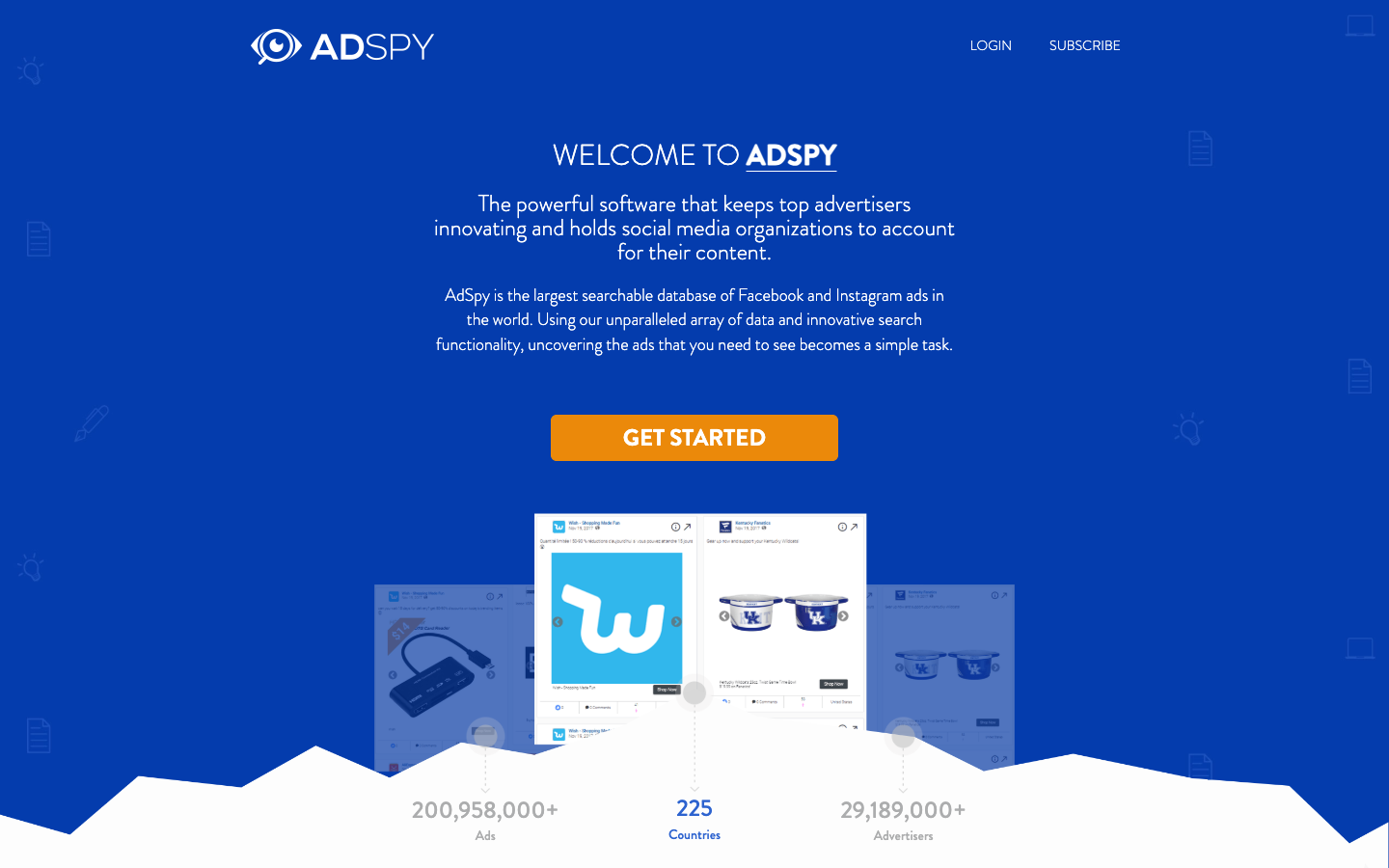
AdSpy claims 200M+ indexed ads as a marketing figure. The deduplication quality behind that number isn’t public, but even a heavily deduplicated version is a large historical dataset.
Affiliate marketer familiarity
AdSpy’s affiliate heritage is real. Since 2015 it’s been the default “which Facebook ads are running” tool in every affiliate marketing course, forum, and YouTube tutorial. If you’re part of the affiliate community, you’ve seen AdSpy screenshots a thousand times. Switching costs are real — existing saved searches, muscle memory in the UI, team workflows built around AdSpy queries.
Meta depth vs multi-platform breadth
AdSpy focuses entirely on Meta. No TikTok, no YouTube, no distraction. For a Meta-only researcher this focus is a feature — the tool does one thing deeply instead of many things thinly. BigSpy and PowerAdSpy cover more platforms but with less depth per platform.
Where AdSpy loses
Dated UI and UX
The AdSpy interface has not materially changed since approximately 2018. Compared to Foreplay (modern agency UX), AdRecon (2026-launch modern design), or even BigSpy (iterated more recently), AdSpy feels older. No dark mode in the default state, no keyboard-driven navigation, no modern design system. Power users who live in the tool adapt; newcomers bounce.
No landing page capture
AdSpy shows you ad creatives and the destination URL. It does not capture landing pages. If you want to archive a funnel or study a landing page offline, you’re on your own — use Waybackmachine, browser screenshot tools, or HTTrack and hope for the best.
AdRecon’s Landing Page Ripper is a direct critique of this gap. BigSpy and Foreplay don’t close the gap either, but they also don’t charge $149/mo to leave it open.
No affiliate network classification
AdSpy has no auto-detection for ClickBank, Digistore24, BuyGoods, MaxWeb, or WarriorPlus. Filter by domain and you’ll catch some; the rest is manual tagging. AdRecon’s regex-based classifier handles this natively because AdRecon was built for affiliate marketers specifically.
No offer intelligence
Aggregate offer views (“all ads running for this ClickBank product”) aren’t first-class in AdSpy. You can work around it by searching for an offer URL fragment, but the workflow is search-centric, not offer-centric. AdRecon’s Winning Offers Directory is a structural critique of this gap.
No creative concept grouping
When the same creative runs across multiple advertisers, AdSpy shows you each instance as a separate ad. AdRecon’s Proven Creatives groups identical creatives with proof levels (15+, 30+, 60+, 90+ linked ads). If you want to surface proven-winner creatives that have worked for multiple advertisers, AdSpy’s ad-by-ad view makes this harder than it needs to be.
No free trial, no cheaper entry tier
$149/mo is the floor. There’s no $29/mo tier, no free plan. The 3-day money-back policy acts as a substitute trial, but it requires you to pay first and request a refund. For budget-conscious first-timers this is an effective filter — AdSpy isn’t the tool for tire-kickers.
Pricing
AdSpy pricing tiers
AdSpy
$149 /month
Virtually unlimited usage
1 seat included
- Facebook + Instagram ad database (AdSpy claims 200M+ ads indexed)
- Boolean search operators
- Search by ad text, page name, URL, comments
- Filter by affiliate network, affiliate ID, Offer ID, landing page technologies
- Demographic filters (location, gender, age range)
- Comment search — user reactions inside ad comments
- Advertiser coverage across 225 countries and 88 languages
- Single plan — one price, one tier
Pricing analysis
$149/month. One tier. No annual discount published. No free trial. 3-day money-back guarantee.
Annual cost: $1,788/year recurring.
Compared to AdRecon ($299 lifetime): AdSpy costs $1,489 more in year one, $3,277 more over two years, $5,065 more over three years — at AdRecon’s current price.
Compared to BigSpy VIP ($249/mo): AdSpy is $100/mo cheaper than BigSpy’s top tier but doesn’t get you BigSpy’s multi-platform coverage.
Compared to Foreplay Agency ($99/mo): AdSpy is $50/mo more expensive with worse UI but deeper search.
For Meta-only researchers who are high-volume and need Boolean queries, the price holds. For budget-constrained affiliates, AdSpy’s pricing is the main reason AdRecon gets recommended over it.
Who AdSpy is for
Use cases
Who should use which?
Meta-only affiliate marketer with $150+/mo tool budget
Good fit if Boolean search matters to your workflow. Supplement with a landing-page capture tool since AdSpy doesn't do that.
Our pick: AdSpyPower user who writes repeatable search queries
AdSpy's Boolean operators are genuinely hard to replace. Worth the premium if you operate this way.
Our pick: AdSpyResearcher needing Meta ads from 2018-2022
AdSpy's historical depth beats any newer tool.
Our pick: AdSpySolo CPA affiliate running ClickBank / Digistore offers
AdRecon fits better — it auto-classifies affiliate networks, has a Landing Page Ripper, and is cheaper over a 3+ month horizon.
Our pick: AdReconTikTok-first marketer
Skip AdSpy. Use PiPiADS for TikTok depth.
Our pick: PiPiADSCreative strategist at an agency
Foreplay fits better — modern UI, briefs, swipe files, client workflows.
Our pick: ForeplayAdSpy vs AdRecon
Both cover Meta. Neither covers TikTok. They take opposite approaches to pricing and feature scope.
AdSpy wins on: Boolean search depth, historical DB span (2015-present vs AdRecon’s 2026-present), market familiarity since 2015, singular Meta focus executed for a decade.
AdRecon wins on: Affiliate-network classification (ClickBank, Digistore24, BuyGoods, MaxWeb, WarriorPlus), Landing Page Ripper (unique), Winning Offers Directory (unique), Proven Creatives grouping across advertisers, dead-creative tracking (is_active flag), $299 lifetime vs $149/mo recurring, modern UI.
Comparison
Head-to-head comparison
Data as of April 2026. Competitor claims are cited as claims, not facts.
| Dimension |  AdRecon AdRecon |  AdSpy AdSpy |
|---|---|---|
| Starting price | Custom | $149/mo |
| Free trial | No | No |
| Platforms | Meta (Facebook), Meta (Instagram), Meta (Threads) | Meta (Facebook), Meta (Instagram) |
| Landing pages | 10.0 | 3.0 |
| Offer intelligence | 10.0 | 3.0 |
| Coverage | 7.0 | 7.0 |
| Data freshness | 9.0 | 7.0 |
| UX | 8.0 | 5.0 |
| Affiliate focus | 10.0 | 8.0 |
| Search & filters | 8.0 | 9.0 |
For the full head-to-head with pricing math and use-case scenarios, read AdRecon vs AdSpy.
Pros and cons
Pros & cons
What AdSpy does well — and where it falls short
Pros
- Very large Facebook and Instagram ad database (AdSpy claims 200M+ ads)
- Boolean search operators — deepest query language among affiliate-facing spy tools
- Built by affiliates for affiliates — search by affiliate network, affiliate ID, and Offer ID
- Long market tenure (since ~2015) means deep historical archive
- Comment search surfaces user reactions competitors miss
- 225-country, 88-language coverage for global affiliate research
Cons
- No free trial — $149 commitment before seeing the product
- UI has not been meaningfully updated in years and feels dated vs newer tools
- No landing page capture or archive feature
- No creative grouping across advertisers (no "proven creatives" concept)
- No dedicated offer intelligence directory
- Meta-only — no TikTok, YouTube, or Google coverage
- $149/month floor excludes smaller operators and new affiliates
Final verdict
AdSpy earns its place for power users who want Meta-only depth with Boolean search, and for researchers who need historical database span. For everyone else — solo affiliates on tighter budgets, anyone needing landing-page archives or offer intelligence, multi-platform marketers — AdSpy is the wrong tool at the wrong price.
The $149/mo pricing is the tool’s main filter. If you can justify $1,788/year for Boolean search and historical depth alone, AdSpy holds up. If you want more functionality per dollar, AdRecon, BigSpy, or Foreplay all deliver more for less — just with different tradeoffs.